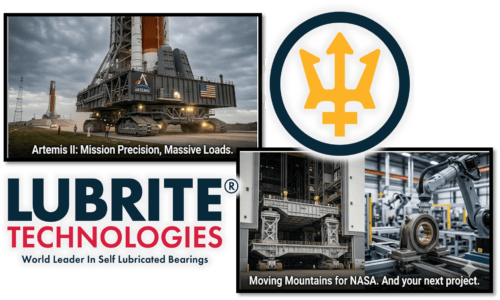


“ARTEMIS IS ROARING… AND LUBRITE TECHNOLOGIES IS THE QUIET MECHANISM THAT MAKES IT POSSIBLE”
Field Dispatch from the Ground Systems Beat — where the rocket meets reality.

Lead Story: Artemis II lit the fuse — and now the infrastructure sprint begins
If you watched the Artemis II story unfold, you probably saw the headline moment: launch, translunar flight, lunar fly‑around, return. What you didn’t see (because it’s mostly steel, bearings, and unglamorous engineering) is the part that determines whether the next mission gets built, processed, stacked, and rolled on schedule: the ground hardware’s ability to move precisely under absurd loads, in harsh coastal environments, with minimal downtime. [nasa.gov], [nasa.gov]
NASA’s own post‑mission flow makes the point. After Artemis II, the mobile launcher makes the trek back and is brought inside the Vehicle Assembly Building (VAB) so teams can inspect, repair, and prep for the next round of stacking operations. That’s not “supporting cast” work — it’s the bottleneck that controls cadence. [nasa.gov], [nasa.gov]
And NASA’s program architecture explicitly leans into cadence: the agency described adding a 2027 mission to test capabilities “closer to home” before pushing toward a crewed lunar landing in 2028, i.e., a structured ramp where operational rhythm matters as much as flight hardware. [nasa.gov], [nasa.gov]
Artemis is not just a rocket program. It’s a motion‑control program—on Earth. [nasa.gov], [lubritetec…logies.com]
Breaking: The “invisible” Artemis headline is movement
Let’s translate Artemis hype into engineering truth:
- The VAB is the hub where giant elements are integrated, and access platforms must reposition around the vehicle during processing. NASA details how upgraded work platforms are installed in the VAB to surround the rocket and allow access during mission processing. [nasa.gov], [lubritetec…logies.com]
- The VAB is not a normal building. NASA describes it as one of the largest buildings in the world by volume, ~525 feet tall, covering eight acres—and purpose‑built to vertically assemble the largest launch systems. [nasa.gov], [nasa.gov]
- NASA’s cadence plan means that every turnaround cycle becomes sacred: rollout, refurbishment, platform movements, structural compliance, and repeat. [nasa.gov], [nasa.gov]
That’s where Lubrite Technologies comes in, playing the best unsung role in action cinema: the mechanism that allows industrial giants to glide as if gravity were merely a suggestion.
ENTER: Lubrite Technologies ® at Kennedy Space Center — the bearing technology inside the Artemis machine
Lubrite Technologies own NASA/ Kennedy Space Center case write‑up:
NASA relied on Lubrite Technologies for large moveable structures at Kennedy Space Center, including upgrades tied to launch pad rotary structures and the moveable platform ecosystem. [lubritetec…logies.com], [lubritetec…logies.com]
Where Lubrite shows up (and why it matters):
1) Launch Pad Rotary Bridge Systems (Pads 39A/39B legacy infrastructure)
Lubrite Technologies reports NASA contracted them to design and manufacture the main bearing facilitating movement of rotary bridge structures at Launch Pads 39A & 39B—systems that must move reliably under heavy loading and exposure. [lubritetec…logies.com], [lubritetec…logies.com]
2) VAB Moveable Assembly Platforms (Artemis‑era refurbishment and flexibility)
Lubrite Technologies states that self‑lubricating bearings are essential for new moveable assembly platforms in the VAB refurbishment context—exactly the kind of flexible ground architecture NASA describes for modern multi‑mission processing. [lubritetec…logies.com], [nasa.gov]
3) Coastal reality: heat + salt water + load
Lubrite Technologies explicitly notes their assemblies were designed to operate under extreme loads and exposure to heat and salt water—a brutally honest description of Kennedy Space Center environment. [lubritetec…logies.com], [lubritetec…logies.com]
Tribology is the secret language of Artemis
The rocket is flashy. A bearing is civilization.
Why bearings are existential to a spaceport
In tribology (the science of friction, wear, and lubrication), you’re fighting a microscopic war: metal surfaces look smooth to us but are jagged landscapes of asperities that interlock and resist motion underload. Lubrite Technologies l catalog explains this: friction is driven by asperity interlocking; under extreme conditions you can even get galling, fretting, or cold‑pressure welding in unlubricated contacts. [lubritetec…logies.com], [lubritetec…logies.com]
Lubrite Technologies approach is a materials‑and‑mechanisms solution: a self‑lubricating film designed to minimize direct contact and shear easily. The catalog uses a wonderfully visual analogy: a laminar, crystalline structure that shears like a deck of cards sliding planes moving over planes with low resistance. [lubritetec…logies.com], [lubritetec…logies.com]
Why “self‑lubricating” is a superpower at Kennedy Space Center
If you can’t easily service a bearing (because it’s buried in an enormous structure, in a harsh environment, under mission schedule pressure), then maintenance is not just expensive — it’s program risk. Lubrite Technologies emphasizes permanent self‑lubrication and the elimination of supplementary lubrication/maintenance as a key feature set. [lubritetec…logies.com], [lubritetec…logies.com]
Translation:
In a spaceport, “low maintenance” isn’t convenience. It’s launch cadence insurance. [nasa.gov], [nasa.gov]
The Lubrite Technologies Lineup product/application list:
✅ Lubrite® Bronze Flat Plates — structural expansion & contraction
These help structures move without cracking themselves apart as temperature and load cycles drive expansion/contraction in large systems. [lubritetec…logies.com], [nasa.gov]
✅ Lubrite® Bronze Bearing Assemblies — multi‑axis loading + rotation
Multi‑axis bearing architectures matter when structures don’t just rotate; they also translate and accommodate complex load paths during repositioning and operations. [lubritetec…logies.com], [lubritetec…logies.com]
✅ T7 Lubrite® Bronze Bushings — rotation at high temperatures
High‑temperature operation is a well-known design stressor for bearing materials; Lubrite Technologies catalog discusses how temperature can alter material properties and drive geometric/stress issues, motivating engineered material/lubricant selections. [lubritetec…logies.com], [lubritetec…logies.com]
✅ Bronze Flange Bushings — thrust + rotation accommodation
When the load isn’t purely radial, flanges handle thrust components while still enabling rotation—critical in constrained mechanisms where loads do not behave politely. [lubritetec…logies.com], [lubritetec…logies.com]
Why the Artemis II → Artemis III hype cycle quietly points to Lubrite Technologies
NASA states the Artemis program is shifting to emphasize risk‑reduction steps and operational cadence — including a 2027 mission focused on rendezvous/docking capability validation in low‑Earth orbit before pushing the first crewed lunar landing target in 2028. [nasa.gov], [nasa.gov]
And here’s the key: that strategy only works if the ground segment can turn hardware quickly and predictably. The VAB’s modernization is explicitly about flexible processing, and NASA highlights the role of new platform systems and upgraded infrastructure inside the facility. [nasa.gov], [nasa.gov]
Lubrite Technologies / NASA/ Kennedy Space Center work is directly in that lane: bearings that enable movement of massive platforms and structures while holding tight tolerances and performing under harsh exposure. [lubritetec…logies.com], [lubritetec…logies.com]
“Artemis speeds up by mastering movement — and the movement technology is bearings.” [nasa.gov], [lubritetec…logies.com]
From the Moon to Your Shop Floor
If Lubrite is the choice for NASA’s deep-space missions, imagine the impact we can have on your next project.
The same “quiet tech” that keeps the Artemis program on schedule at Kennedy Space Center is ready to work for you. We don’t just make bearings; we provide the mechanical backbone for the world’s most ambitious engineering feats.
Whether it’s the mobile launchers at the VAB or the precision motion required for your specific industrial workflows, Lubrite specializes in making the massive feel weightless.
Why trust Lubrite Technologies with your project?
- Extreme Load Management: Proven to handle the weight of the Artemis flight stack.
- Harsh Environment Expertise: Engineered for conditions where standard components fail.
- Mission-Critical Reliability: When “risk reduction” is the priority, we are the documented choice.
If we can move mountains for NASA, we can move them for you.Let’s discuss how we can bring space-grade precision to your company’s next big move.